Case study
SeaBoard User Onboarding

Overview
I redesigned SeaBoard's manual onboarding flow into a self-serve experience, reducing lead time from 1 week to minutes
Company
SeaBoard Technologies
Role
Product designer
Responsibility
User flow, information architecture, interaction design, visual design, design system
Impact
Reducing lead time from 1 week to minutes
Background
Seaboard is a personal banking platform for seafarers to manage finances onboard or onshore


Problem & goal
Business goal of scaling user base 5x is hindered by long onboarding lead time resulting from manual processes
Our initial onboarding process was intentionally manual to quickly launch the product and validate the business idea. As the user base grew, the onboarding flow limited user growth and prevented rapid scaling.
The project goal is to redesign the onboarding process to support onboarding seafarers at scale.
Research
Research conducted with the Customer Success (CS) team to understand operational and user pain points
I conducted interviews with the ops team to identify operational challenges and pain points faced by seafarers during sign-up. The current onboarding flow had 4 broad steps, each with critical UX issues due to manual workflows:
💾 Manual data collection and account creation
Ops team manually collects personal information and documents from interested seafarers for account creation.
👤 Manual identity verification and updates
Ops notifies partners manually for identity verification. Partners manually verify identities and update ops once completed.
📧 Manual invitation email triggering
After verification, ops manually sends account activation emails to users via the system.
🔄 Missing invitation email, synchronisation issues
Seafarers miss invitation emails due to email oversight or synchronisation issues (bad internet connection at sea).
Ideation
Collaborative session with product team to explore and define ideal onboarding flow
The product team proposed 3 options for streamlining the onboarding process:
Assisted
Operations team collects seafarer information from employer systems for account creation, and seafarers complete automated identity verification
Self-serve
Seafarers fill in information and complete automated identity verification themselves
Automated self-serve
Seafarers fill in information using automated form filling (SingPass-like) and complete automated identity verification themselves
The team selected the Self-Serve approach based on 4 key factors:
Minimal steps
Minimal identity verification time
Minimal human dependencies
Technical feasibility

Information architecture
Process flow defined based on high-level journey map to identify key screens, user steps, and system interactions
Based on the high-level journey map, I broke down the steps and mapped out a detailed process flow. This helped define the key screens, steps taken on each screen, and user and system interactions.
I then conducted an alignment and working session with the team to align on the process flow and define the back-end APIs required together with the developers.

Wireframing
Screen requirements defined: purpose, content, actions; wireframes developed to visualise solution and review
Once the key screens were identified, I defined the page structure using the core model, considering:
Page purpose
Aligning business goals and user goals with the screen
Page structure and information
Outlined abstractly using priority guides in bullet form

With details outlined, I created wireframes for each page using our component library to visualise the flow and facilitate design reviews.

Design solutions
Users can self-register, submit personal info and docs, eliminate manual data collection and account creation
Seafarers can now sign up independently, supplying their information and creating their accounts without needing manual assistance from the operations team.
As the process can be lengthy, I grouped the steps into 2 key milestones:
Collecting basic information for account creation
Collecting complete personal information for identity verification
This approach:
Breaks down the process into manageable tasks
Allows users to continue or resume later, accommodating seafarers who may not have necessary documents readily available
Provides a sense of progress and accomplishment with each milestone completion
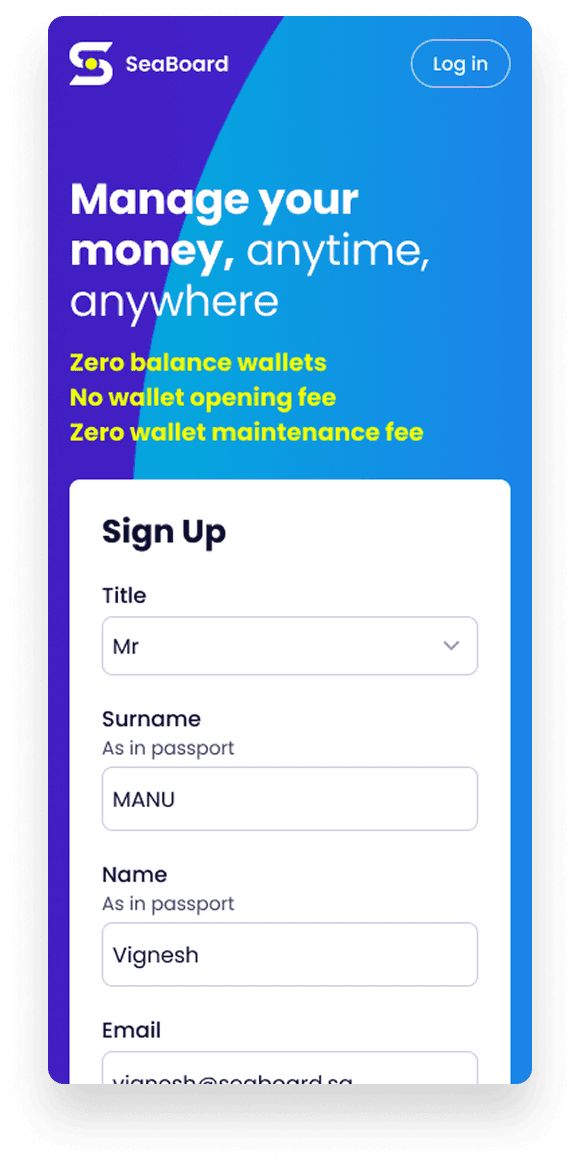

Milestone 1: Enter basic info to create account
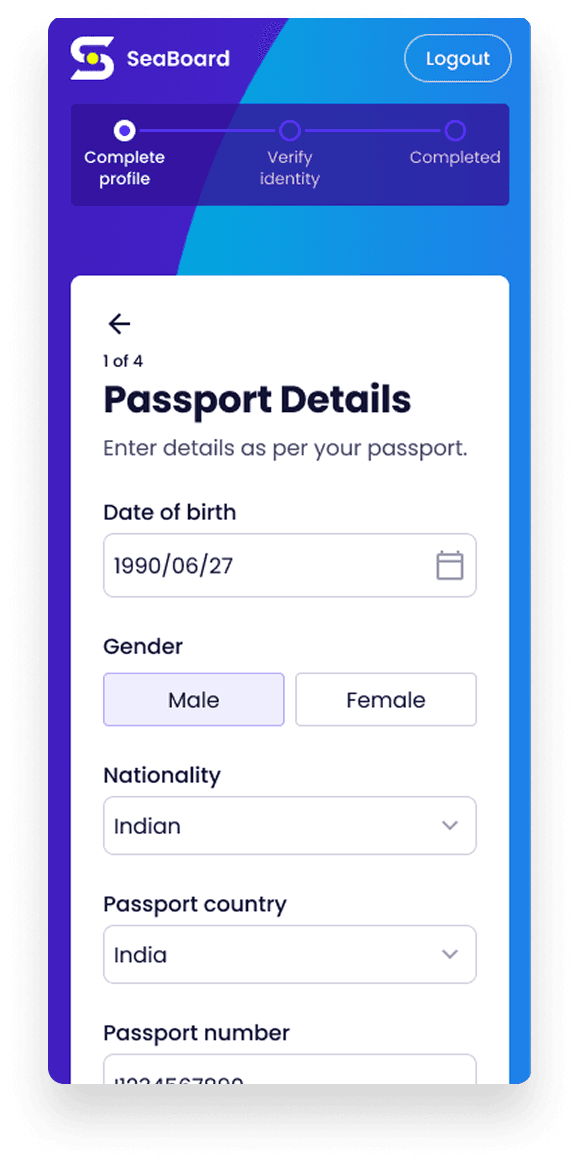


Milestone 2: Enter personal info for identity verification
To enhance the UX of the long form-filling process, I communicated upcoming steps clearly to prepare users on:
What to expect
Required documents
Estimated time needed to complete each step

A wizard pattern with a progress bar was used to help users track their progress, understand where they are in the process, and anticipate how much time remains.

User verifies identity with 3rd party platform automated, eliminate manual verification and updates
Integration with a 3rd-party platform enables automated identity verification, eliminating the need for manual verification.
To provide a seamless experience, I embedded the identity verification workflow within the page templates, allowing users to complete the process independently while maintaining our branding.


Post-identity verification, users download app instantly, eliminate manual invitations and missed emails
Upon completing identity verification, seafarers are directed to download the app, allowing immediate access to the platform.
To facilitate a seamless transition, I designed a clear call-to-action (CTA) at the end of the onboarding workflow, directing seafarers to the relevant app store to download the application based on their device type.

Documentation & handover
Design documentation prepared for developers: UI, components, UI mockups and content specifications
The design documentation was prepared for developers for implementation, including specifications, component requirements, and UI mockups.

Outcome
Onboarding lead time reduced from 5-7 days to minutes, freeing up operational resources
⚡ Reduced lead time from 1 week to minutes
By automating sign-up and identity verification, onboarding no longer requires CS coordination at every step.
🔗 2 intermediaries eliminated
The partner-dependent identity verification step and manual invitation process were fully removed from the flow.
⚙️ Operational resources freed for higher-value work
Removing manual processing released CS team capacity for customer support and other priorities.
Next case study

Connect with me


Zhiyang
Copyright © 2026.